Reading Core Standard Key Ideas & Details 3
Preparation
Divide paper into three columns, with three sections in each column.
Materials
Anansi Does the Impossible by Verna Aardema
Markers
Teaching
1. Read Anansi Does the Impossible by Verna Aardema.
2. Ask your child what the three things were that the Sky God asked Anansi to bring to him.
3. Write each one at the top of each column.
4. Ask your child "How did Anansi capture the python?" In the second section of the column draw, or have your child draw how Anansi captured the python. In the final section of the column write what your child says.
5. Repeat for the fairy and the hornets.
Phonics Core Standard Phonological Awareness 2.a.
Preparation
Write "Snake" at the top of two pages. Divide the sheet into eight sections writing "__ake" in each section
Cut a piece of paperinto small squares writing each consonant on a square, also add "st," "sh"
Put squares in a baggie
Materials
Baggie with letters
2 sheets of paper with "Snake' written at top and "__ake" in the eight sections
Teaching
This is a game!!
1. First person pulls a letter from the bag and puts in front of "ake."
2. If this makes a word, they keep the letter in front of "ake."
3. Second person pulls a letter, puts it in front of word. If it doesn't from a word they put it in the cast off pile (we called it the "eh-eh pile")
4. The first person to create eight words wins.
5.After you are done creating words, use a marker and write the letters you pulled in front of "___ake" to make the words.
**To watch me teach this go to
Writing Core Standard
Preparation
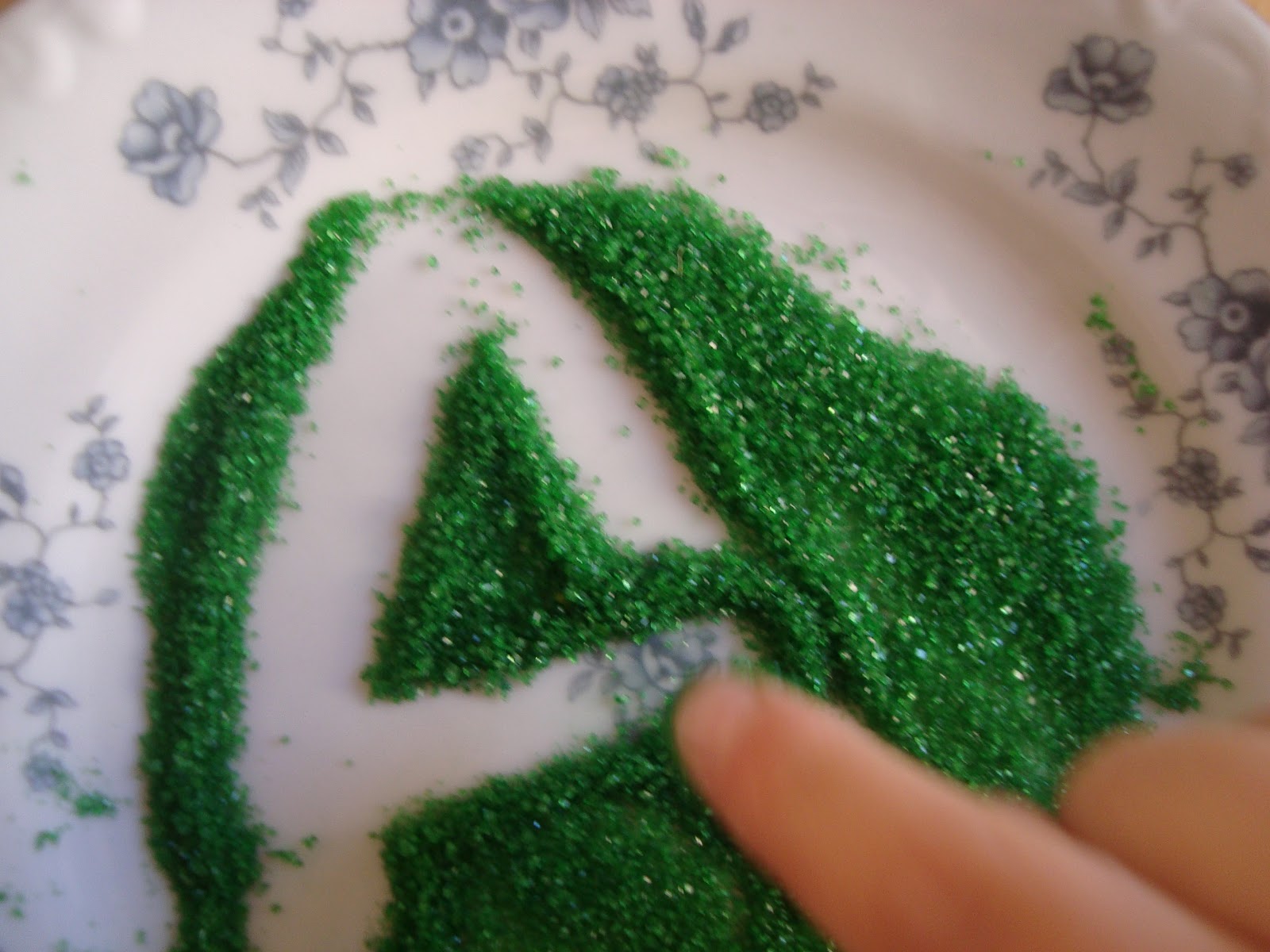
Pour colored sugar or jell-o in a thin layer on a plate
Materials
jell-o/sugar
Teaching
1. Show your child how to form the letter "A," and "a."
2. Let them write the letters, one at a time, in the sugar.
3.The fun is being able to lick your fingers as you write the letter!
**This sis great for tactile learning!
Math Core Standard - Counting & Cardinality 4.a.
Preparation
Make a mini book writing the numbers 1-20 with one number on each page
Materials
Mini book
Stamps or stickers
Teaching
1. Have your child stamp the number of animals that are written on the page (stamp one bunny for the number one, 2 cats for 2, etc).
2. Do this for each number up to 20.
Art
Preparation
Get a paper plate or large paper bag
markers or crayons
Materials
Get a paper plate or large paper bag
markers or crayons
scissorsTeaching
1. Have your child create an Anansi mask.
**My son really doesn't like art, so his mask was as simple as he could make it. A circle cut out of bag, circles cut out for eyes and he was Anansi. He thought for sure he was going to scare his older sister when she came home from school.
Showing posts with label free lesson plans. Show all posts
Friday, March 16, 2012
Friday, February 10, 2012
Valentines - Day 1
Reading Core Standard Craft & Structures 6, 7, 10
Preparation
none
Materials
How Do Dinosaurs Say I Love You? by Jane Yolen & Mark Teague
Teaching
1. On the cover of the book point out the author and illustrator.
2. Explain the job of the author (to write the words) and the illustrator (to draw pictures to show what the words are saying).
3. After reading each page, ask your child, "How does the illustrator show this?"
This is how I teach it (YouTube video).
Phonics Core Standard Phonics 3.c.
Preparation
In highlighter or marker write the following words on a piece of paper:
the, to and, is
Preparation
none
Materials
How Do Dinosaurs Say I Love You? by Jane Yolen & Mark Teague
Teaching
1. On the cover of the book point out the author and illustrator.
2. Explain the job of the author (to write the words) and the illustrator (to draw pictures to show what the words are saying).
3. After reading each page, ask your child, "How does the illustrator show this?"
This is how I teach it (YouTube video).
Phonics Core Standard Phonics 3.c.
Preparation
In highlighter or marker write the following words on a piece of paper:
the, to and, is
Materials
Newspaper article
Highlighters or Light Markers in various colors
Teaching
1. Have your child take the marker in the corresponding color and highlight each "the" in the article. (In other words, you have written the word "the" in pink, so your child takes a pink marker and finds all "the"'s in the text and highlights them in the pink marker.
2. Repeat for the other words.
3. As your child looks for the words they may find others they missed, so keep all the markers handy.
Writing Core Standard Conventions of English 1.a.
Preparation
Create a race track in the form of the letter "V" on a piece of paper Write "Go" at beginning of letter and "stop" at the end
MaterialsPreparation
Create a race track in the form of the letter "V" on a piece of paper Write "Go" at beginning of letter and "stop" at the end
"V" track
Small toy car
Teaching
1. Have your child push the toy car along the "V" track, starting at go, and ending at "Stop."
2. Do not let your child go backward. This is about practicing the letter formation of "V."
3. Let your child race different cars, different speeds, along the track.Math Core Standard - Comparing Numbers 6
Preparation
Create a chart with the different color hearts from a box of conversation hearts with a column for each color
Materials
ChartBox of conversation hearts
Teaching
1. Have child open box of hearts and arrange hearts in their columns.
2. Ask which column has more or less than the other columns. Ask which column has the most, which has the least.
3. Ask, "How many hearts from this column would you have to eat to have equal hearts with that column?"
4. Eat some hearts
Watch me teach this here
Art
Preparation
Materials
PaperTeaching
1. Have child open box of hearts and arrange hearts in their columns.
2. Ask which column has more or less than the other columns. Ask which column has the most, which has the least.
3. Ask, "How many hearts from this column would you have to eat to have equal hearts with that column?"
4. Eat some hearts
Watch me teach this here
Art
Preparation
Materials
Scissors
GlueMarkers
Stickers
Teaching
1. Teach your child how to cut hearts from paper.
2. Have your child create a Valentine for someone they love.
3. Have them decorate it. You can have them write "I Love You" because seeing "I love you" in child writing is the best Valentine present ever.
Teaching
1. Teach your child how to cut hearts from paper.
2. Have your child create a Valentine for someone they love.
3. Have them decorate it. You can have them write "I Love You" because seeing "I love you" in child writing is the best Valentine present ever.
4. Your child can create as many Valentines as he would like. For my son that was one Valentine. For my daughter who joined us that was several.
Tuesday, February 7, 2012
Space - Day 3
Reading Core Standard Range of Reading 7
Preparation
Materials
Cat in the Hat: There's No Place Like Space by Tish Rabe
Teaching
1. Before reading each page to your child have them be a detective and look for clues in the illustration to guess what the words say.
2. Praise your child when they correctly guess the text using illustration clues.
Phonics Core Standard Rhyming words
Preparation
Materials
Teaching
1. Say a space word and have your child come up with a word that rhymes with it. Let your child give you a space word to rhyme. Laugh at your silly rhymes.
Writing Core Standard 1.a.
Preparation
Materials
Computer
Teaching
1. As you read books this week keep an ABC book of words that you learned about space.
2. Help your child type words into computer to form an ABC book.
3. Have your child find pictures on Internet, or print out pages and have your child draw pictures for each letter.
**You'll be working on this book a little each day, don't try to finish in one day, in fact it may take other sessions through out the day to complete the book.**
Our ABC List:
A- Astronomer
B - Bright
C- Constellation
D - Distance
E- Earth
F - Far
G- Galaxy, gravity, Ganymede
H - Hot, huge
I - Io, iron
J - Jupiter
K - Kirkwood Gap (we needed help on this one!)
L - Light, life
M - Milky way, Mars, Mercury, Moon
N - Neptune
O - Orbit
P - Planet
Q - Quick
R - Rotate, rings
S - Solar System, sun, stars, Saturn
T - Titon, telescope
U - Universe, Uranus
V - Venus
W - Water
X - X Marks the spot (I know , we had to stretch it for X! What did you use?)
Y - Years
Z - Zero, Zenith
Math Core Standard - Operations and Algebraic Thinking 3
Preparation
I have boxes of small items that I use for teaching this: stamps, beads, fake leaves, fake flowers, colored blocks, etc.
Materials
Small items
Teaching
1. Tell your child to make the number 5 (or chose a smaller number if 5 is too large) with the items.
2.Ask them to explain each time they create the number 5. For example, "I made three bunny stamps and two giraffe stamps." or "I have five blue beads" or "I have one circle and four rectangles."
3. Write their creation as an equation. Example:
"I made three bunny stamps and two giraffe stamps." Write 3+2= 5.
Say, "Just like words say a story. These numbers tell us what you made." Go through step by step how you created the equation. ("You stamped three bunnies, so I wrote this three. This '+' means you added more. This two says you added the two giraffes."
Art
Preparation
Materials
Large sheet of paper
Water colors
Paintbrushes
Black tempera paint
Teaching
1. Have your child paint their own planet using the water colors.
2.Have your child create the space around the planet using the black tempera paint.
** My son wanted half his planet to be in daylight, half at night so he only painted half of his paper black
Preparation
Materials
Cat in the Hat: There's No Place Like Space by Tish Rabe
Teaching
1. Before reading each page to your child have them be a detective and look for clues in the illustration to guess what the words say.
2. Praise your child when they correctly guess the text using illustration clues.
Phonics Core Standard Rhyming words
Preparation
Materials
Teaching
1. Say a space word and have your child come up with a word that rhymes with it. Let your child give you a space word to rhyme. Laugh at your silly rhymes.
Writing Core Standard 1.a.
Preparation
Materials
Computer
Teaching
1. As you read books this week keep an ABC book of words that you learned about space.
2. Help your child type words into computer to form an ABC book.
3. Have your child find pictures on Internet, or print out pages and have your child draw pictures for each letter.
**You'll be working on this book a little each day, don't try to finish in one day, in fact it may take other sessions through out the day to complete the book.**
Our ABC List:
A- Astronomer
B - Bright
C- Constellation
D - Distance
E- Earth
F - Far
G- Galaxy, gravity, Ganymede
H - Hot, huge
I - Io, iron
J - Jupiter
K - Kirkwood Gap (we needed help on this one!)
L - Light, life
M - Milky way, Mars, Mercury, Moon
N - Neptune
O - Orbit
P - Planet
Q - Quick
R - Rotate, rings
S - Solar System, sun, stars, Saturn
T - Titon, telescope
U - Universe, Uranus
V - Venus
W - Water
X - X Marks the spot (I know , we had to stretch it for X! What did you use?)
Y - Years
Z - Zero, Zenith
Math Core Standard - Operations and Algebraic Thinking 3
Preparation
I have boxes of small items that I use for teaching this: stamps, beads, fake leaves, fake flowers, colored blocks, etc.
Materials
Small items
Teaching
1. Tell your child to make the number 5 (or chose a smaller number if 5 is too large) with the items.
2.Ask them to explain each time they create the number 5. For example, "I made three bunny stamps and two giraffe stamps." or "I have five blue beads" or "I have one circle and four rectangles."
3. Write their creation as an equation. Example:
"I made three bunny stamps and two giraffe stamps." Write 3+2= 5.
Say, "Just like words say a story. These numbers tell us what you made." Go through step by step how you created the equation. ("You stamped three bunnies, so I wrote this three. This '+' means you added more. This two says you added the two giraffes."
Art
Preparation
Materials
Large sheet of paper
Water colors
Paintbrushes
Black tempera paint
Teaching
1. Have your child paint their own planet using the water colors.
2.Have your child create the space around the planet using the black tempera paint.
** My son wanted half his planet to be in daylight, half at night so he only painted half of his paper black
Space - Day 2
Sad News - I can not find any of the pictures I took from this day. I'm so sorry! I have the video from our Math, though.
Reading Core Standard Reading 8Preparation
Create a solar system on a large piece of paper labeling the sun and each of the 8 planets. Leave room on or next to each planet to record information learned.
Materials
Solar system paper
Pen
The Planets by Gail Gibbons
Teaching
1. Read the book The Planets by Gail Gibbons.
2.After reading return to the book and look at each page. Have your child tell you one or more things he learned about that planet. Record what he learned on or in the planet.
Phonics Core Standard Phonemic Awareness 2.d.,e.
Preparation
Write the word "Planet" on a piece of paper. Cut into individual letters.
Materials
Cut up word
Teaching
1. Have your child use the letters from the word "Planets" to create the following words in order.
2. at, pat, sat, set, pet, let, net, ten, pen, pan, tan, tap, lap, sap, nap
3. When you teach this say, "Make the word "at."
4. "Add a letter to make "Pat."
5."Change a letter to make "sat." Etc.
Writing Core Standard 1.a.
Preparation
Materials
Computer
Teaching
1. As you read books this week keep an ABC book of words that you learned about space.
2. Help your child type words into computer to form an ABC book.
3. Have your child find pictures on internet, or print out pages and have your child draw pictures for each letter.
**You'll be working on this book a little each day, don't try to finish in one day, in fact it may take other sessions through out the day to complete the book.**
Our ABC List:
B - Bright
C- COnstellation
D - Distance
E- Earth
F - Far
G- Galaxy, gravity, Ganymede
H - Hot, huge
I - Io, iron
J - Jupiter
K - Kirkwood Gap (we needed help on this one!)
L - Light, life
M - Milky way, Mars, Mercury, Moon
N - Neptune
O - Orbit
P - Planet
Q - QUick
R - Rotate, rings
S - Solar System, sun, stars, Saturn
T - Titon, telescope
U - Universe, Uranus
V - Venus
W - Water
X - X Marks the spot (I know , we had to stretch it for X! What did you use?)
Y - Years
Z - Zero, Zenith
Math Core Standard - Operations and Algebraic Thinking 4
Preparation
Materials
Deck of cards, jacks, quenns, and kings removed
Teaching
1. Shuffle cards and deal 5 cards to each player.
2. Players go through their cards to see if they can put two cards together to make ten (4+6, 5+5, etc)
3. Players ask each other for cards to make ten (Example: If a player has a seven they ask the other player for a three)
4. If other player doesn't have card asked for then player will "go fish" for another card.
5. When player has two cards that equal ten they have a match and get to keep it.
6. Player with most matches wins.
Watch how we play here
Art
Preparation
Materials
Black paper
Glue stick
Glitter
Circles cut out of colored paper
Ellipses cut out of colored paper, with center cut out (these become rings for the plantets)
Teaching
1. Have child rub glue stick all over paper.
2. Have child sprinkle glitter all over paper.
3. Have child arrange plantes all over paper.
Voila! A solar system!
Labels:
art,
free lesson plans,
kindergarten,
math games,
planets,
preschool,
Space
Monday, January 23, 2012
Three Little Pigs - Day 3
Reading Core Standard Integration of Knowledge and Ideas 9
Preparation
Materials
The True Story of the Three Little Pigs by Jon Scieszka
Three Little Pigs
Teaching
1. Show your child the book Three Little Pigs. Ask, "Is the wolf a good guy or bad guy?"
2. Show your child the book The True Story of the Three Little Pigs and say, "The wolf wrote his own story about what happened. This is what the wolf said."
3. Read The True Story of the Three Little Pigs.
4. Ask, "Does this story make the wolf seem nicer? What do you think of the wolf in this story? Did he still eat the pigs? What happened to him at the end of the three pigs? What happened to him at the end of this story? Who do you believe? Do you believe the wolf's story about getting sugar, or do you think he wanted to just eat the pigs? Is the wolf a good guy or bad guy?"
Phonics Core Standard Phonological Awareness 2.c.,d.,e
Preparation
Make a small flip book with 27 sheets of paper (see my video here of how I did it)
Cut book in half from bottom to fold at top
Write one of each of the following letters on each page of the first half of the book: b,c,d,f,g,h,j,k,l,m,n,p,qu,r,s,t,v,w,x,y,z, bl, st, sp, tr, gl, sn
Write one of each of the following rimes on each page of the second half of the book:
ack, ad, ag, am, an, ap, at, ed, ell, en, et, ick, id, ig, ill, in, ip, it, ock, og, op, ot, ub, ug, um, un, ut
Materials
book
Teaching
1. Using the book flip to any beginning sound (first half of book) and any rime (second half of book) have your child sound it out to create a word.
2. Keep this with other books and continue practicing sounding out the new words.
Writing Core Standard - Text Types and Purposes 1.
Preparation
Write on a piece of paper "The wolf is..."
Materials
Paper
Markers
Teaching
1.Ask your child whether they think the wolf is good or bad and why.
2. Write, or help your child to write, their opinion on the piece of paper.
3. Have your child illustrate their opinion.
Math Core Standard - Operations and Algebraic Thinking 3
Preparation
I have boxes of small items that I use for teaching this: stamps, beads, fake leaves, fake flowers, colored blocks, etc.
Materials
Small items
Teaching
1. Tell your child to make the number 7 (or chose a smaller number if 7 is too large) with the items.
2.Ask them to explain each time they create the number 7. For example, "I made three bunny stamps and four giraffe stamps." or "I have five blue beads and two red beads" or "I have one circle and six rectangles."
3. Write their creation as an equation. Examples:
"I made three bunny stamps and four giraffe stamps." Write 3+4=7
or "I have five blue beads and two red beads" Write 5+2=7
or "I have one circle and six rectangles." Write 1+6=7
4. Say, "Just like words say a story. These numbers tell us what you made." Go through step by step how you created the equation. ("You stamped five bunnies, so I wrote this five. This '+' means you added more. This two says you added the two giraffes."
Exploration
Preparation
Get some Legos or other interlocking blocks
Materials
Legos
Teaching
1. Have your child create a house made out of bricks with you. Have fun making the sides and roof of the pig's house. Talk about the colors you are using, the size of the house, how many bricks. Make it a great learning and doing together experience.
Art
Preparation
Materials
Paper
Art Supplies (your choice of paint, crayon, marker, colored pencil, etc)
Teaching
1. Have your child draw (paint, etc) a picture of his house.
Preparation
Materials
The True Story of the Three Little Pigs by Jon Scieszka
Three Little Pigs
Teaching
1. Show your child the book Three Little Pigs. Ask, "Is the wolf a good guy or bad guy?"
2. Show your child the book The True Story of the Three Little Pigs and say, "The wolf wrote his own story about what happened. This is what the wolf said."
3. Read The True Story of the Three Little Pigs.
4. Ask, "Does this story make the wolf seem nicer? What do you think of the wolf in this story? Did he still eat the pigs? What happened to him at the end of the three pigs? What happened to him at the end of this story? Who do you believe? Do you believe the wolf's story about getting sugar, or do you think he wanted to just eat the pigs? Is the wolf a good guy or bad guy?"
Phonics Core Standard Phonological Awareness 2.c.,d.,e
Preparation
Make a small flip book with 27 sheets of paper (see my video here of how I did it)
Cut book in half from bottom to fold at top
Write one of each of the following letters on each page of the first half of the book: b,c,d,f,g,h,j,k,l,m,n,p,qu,r,s,t,v,w,x,y,z, bl, st, sp, tr, gl, sn
Write one of each of the following rimes on each page of the second half of the book:
ack, ad, ag, am, an, ap, at, ed, ell, en, et, ick, id, ig, ill, in, ip, it, ock, og, op, ot, ub, ug, um, un, ut
Materials
book
Teaching
1. Using the book flip to any beginning sound (first half of book) and any rime (second half of book) have your child sound it out to create a word.
2. Keep this with other books and continue practicing sounding out the new words.
Writing Core Standard - Text Types and Purposes 1.
Preparation
Write on a piece of paper "The wolf is..."
Materials
Paper
Markers
Teaching
1.Ask your child whether they think the wolf is good or bad and why.
2. Write, or help your child to write, their opinion on the piece of paper.
3. Have your child illustrate their opinion.
Math Core Standard - Operations and Algebraic Thinking 3
Preparation
I have boxes of small items that I use for teaching this: stamps, beads, fake leaves, fake flowers, colored blocks, etc.
Materials
Small items
Teaching
1. Tell your child to make the number 7 (or chose a smaller number if 7 is too large) with the items.
2.Ask them to explain each time they create the number 7. For example, "I made three bunny stamps and four giraffe stamps." or "I have five blue beads and two red beads" or "I have one circle and six rectangles."
3. Write their creation as an equation. Examples:
"I made three bunny stamps and four giraffe stamps." Write 3+4=7
or "I have five blue beads and two red beads" Write 5+2=7
or "I have one circle and six rectangles." Write 1+6=7
4. Say, "Just like words say a story. These numbers tell us what you made." Go through step by step how you created the equation. ("You stamped five bunnies, so I wrote this five. This '+' means you added more. This two says you added the two giraffes."
Exploration
Preparation
Get some Legos or other interlocking blocks
Materials
Legos
Teaching
1. Have your child create a house made out of bricks with you. Have fun making the sides and roof of the pig's house. Talk about the colors you are using, the size of the house, how many bricks. Make it a great learning and doing together experience.
Art
Preparation
Materials
Paper
Art Supplies (your choice of paint, crayon, marker, colored pencil, etc)
Teaching
1. Have your child draw (paint, etc) a picture of his house.
Three Little Pigs - Day One
Reading Core Standard Key Ideas & Details 3 - Characters, setting, Major events; Craft & Structure 5 - Recognize common types of text & 6 - Author and illustrator and role of each
Preparation
Divide four pieces of paper into five sections each
On Top of first section write: Who, second section: Where/When third section: What, Fifth section: Why.
On first piece of paper write Pig One with a picture of Pig One
Second piece of paper write pig 2 with picture of pig 2
Third piece of paper write Pig 3, with picture of Pig 3
Fourth Piece of Paper write Wolf with picture of wolf
Materials
Book: Three Little Pigs, I used the books by James Marchall and Margot Zemach, but there are dozens to choose from
Divided sheets
Markers
Teaching
1. Read The Three Little Pigs. Before opening the book, point out the title, author and illustrator. Tell your child this is a storybook.
Here is how I pointed out author, title, etc:
2. Fill out a divided paper for each character.
3. Tell your child who the character is. Make sure to use proper terms (character)
4. Ask where the pig was (city, forest, etc). Have your child draw a picture or write a word describing where the story takes place
5. Ask when the story happened (night, spring, look at details in pictures for clues). Have your child draw or write in the column to summarize when the story takes place.Say, "This is the setting; when and where the story happens is the setting."
6. Ask What pig 1 did. Have child draw or write in the "What" column what Pig 1 did.
7. Ask why Pig 1 did what he did. Have child draw or write in last column why Pig one did what he did.
8. Repeat for remaining characters.
**Learning takes place on a spectrum from teacher directed (you telling, doing, child listening) to teacher-child (doing project together) to independent (Child doing learning all on his own). You can do this project, and any lesson, for that matter, along this spectrum. If you need to direct more, then you fill out the papers. I set up this lesson as a teacher/child to be done together, but gauge your child's abilities and teach accordingly**
Phonics Core Standard Print Concepts, Common High Frequency words
Preparation
On computer write your own, very simple, short Three Little Pigs story, or use mine (email me amyiswrite@gmail.com)
Materials
Book
Highlighters ( I use light colored markers)
Teaching
Preparation
Write dotted lines on the bottom of a blank sheet of paper. Write "My favorite part is..." followed by enough space for child to answer question.
Materials
Paper
Markers, crayons, etc
Teaching
1. Talk about story. Share your favorite parts with each other.
Math Core Standard - Counting and cardinality 2, 4.a., Operations and Algebraic Thinking 1&2
Preparation
Materials
stacking (not interlocking) blocks
Die (one dice)
Teaching
1. Person 1 rolls die, then stacks that number of blocks up on top of each other.
2. Person 2 rolls die, then stacks their blocks on top of blocks person one made. Have person 2 count on to person one's blocks to find out how many blocks there are altogether.
3. Person 1 rolls die again. This number indicates how many "puffs" this person has to blow the "piggie blocks" down.
4. Restack blocks (if necessary). Have person 2 roll die and "puff."
5. The person who can blow down stack in allotted puffs win (which means both people can win).
**I had no trouble blowing down the stacks, but my son did, so we ended up throwing a small block at the stacks**
Exploration
Preparation
Materials
pipe cleaners
Teaching
1.Not having straw readily available, we used pipe cleanersto create our straw house. Talk with your child about how you might put the house together, how to walls, the roof, etc.
2. This doesn't have to be perfect. It's an exercise in building and problem solving.
Art
Preparation
Circle cut out of pink paper for pig nose
two triangles cut out of pink paper for ears
Materials
Pink paint
paper plate
circle, triangles
glue
black marker
Teaching
1. Have child paint paper plate.
2. Have child glue nose and ears of plate.
3.Have child draw mouth.
4. Have child draw eyes for pig.
Preparation
Divide four pieces of paper into five sections each
On Top of first section write: Who, second section: Where/When third section: What, Fifth section: Why.
On first piece of paper write Pig One with a picture of Pig One
Second piece of paper write pig 2 with picture of pig 2
Third piece of paper write Pig 3, with picture of Pig 3
Fourth Piece of Paper write Wolf with picture of wolf
Materials
Book: Three Little Pigs, I used the books by James Marchall and Margot Zemach, but there are dozens to choose from
Divided sheets
Markers
Teaching
1. Read The Three Little Pigs. Before opening the book, point out the title, author and illustrator. Tell your child this is a storybook.
Here is how I pointed out author, title, etc:
2. Fill out a divided paper for each character.
3. Tell your child who the character is. Make sure to use proper terms (character)
4. Ask where the pig was (city, forest, etc). Have your child draw a picture or write a word describing where the story takes place
5. Ask when the story happened (night, spring, look at details in pictures for clues). Have your child draw or write in the column to summarize when the story takes place.Say, "This is the setting; when and where the story happens is the setting."
6. Ask What pig 1 did. Have child draw or write in the "What" column what Pig 1 did.
7. Ask why Pig 1 did what he did. Have child draw or write in last column why Pig one did what he did.
8. Repeat for remaining characters.
**Learning takes place on a spectrum from teacher directed (you telling, doing, child listening) to teacher-child (doing project together) to independent (Child doing learning all on his own). You can do this project, and any lesson, for that matter, along this spectrum. If you need to direct more, then you fill out the papers. I set up this lesson as a teacher/child to be done together, but gauge your child's abilities and teach accordingly**
Phonics Core Standard Print Concepts, Common High Frequency words
Preparation
On computer write your own, very simple, short Three Little Pigs story, or use mine (email me amyiswrite@gmail.com)
Materials
Book
Highlighters ( I use light colored markers)
Teaching
- Starting on page one, word one, say, "This is the first letter of the first word we are going to read. We always start here,on the left side of the page when we read or write. This letter makes a sound. We put it together with the other letters next to it and it tells us a word!
- Have your child tell you the sound of each letter. Put the sounds together to form the word. Underline the word in green. Read the word.
- Say, "This space next to the word tells us the word is done." Color the space red.
- Repeat for each word on the page.
- Say, "We read a sentence!" Underline the sentence in green.
- For the word "the" tell them "This is the word 'the.' We use this word often, but it doesn't look the way it sounds, so we just memorize t-h-e is the." Highlight "the" in blue.
- Repeat this for each sentence.
Preparation
Write dotted lines on the bottom of a blank sheet of paper. Write "My favorite part is..." followed by enough space for child to answer question.
Materials
Paper
Markers, crayons, etc
Teaching
1. Talk about story. Share your favorite parts with each other.
2. Have child write his favorite part on the paper.
3.Have him illustrate it..Math Core Standard - Counting and cardinality 2, 4.a., Operations and Algebraic Thinking 1&2
Preparation
Materials
stacking (not interlocking) blocks
Die (one dice)
Teaching
1. Person 1 rolls die, then stacks that number of blocks up on top of each other.
2. Person 2 rolls die, then stacks their blocks on top of blocks person one made. Have person 2 count on to person one's blocks to find out how many blocks there are altogether.
3. Person 1 rolls die again. This number indicates how many "puffs" this person has to blow the "piggie blocks" down.
4. Restack blocks (if necessary). Have person 2 roll die and "puff."
5. The person who can blow down stack in allotted puffs win (which means both people can win).
**I had no trouble blowing down the stacks, but my son did, so we ended up throwing a small block at the stacks**
Exploration
Preparation
Materials
pipe cleaners
Teaching
1.Not having straw readily available, we used pipe cleanersto create our straw house. Talk with your child about how you might put the house together, how to walls, the roof, etc.
2. This doesn't have to be perfect. It's an exercise in building and problem solving.
Art
Preparation
Circle cut out of pink paper for pig nose
two triangles cut out of pink paper for ears
Materials
Pink paint
paper plate
circle, triangles
glue
black marker
Teaching
1. Have child paint paper plate.
2. Have child glue nose and ears of plate.
3.Have child draw mouth.
4. Have child draw eyes for pig.
Saturday, January 7, 2012
Frogs - Day 3
Reading Core Standard - Reading Standards for Informational Text1
Preparation
This will be asking and answering questions about the text.
Materials.
book - I used Gail Gibbons Frogs again
Teaching
1. Read book Frogs by Gail Gibbons. Ask your child questions about the book. Ask if they have questions.
Phonics Core Standard - Phonological Awareness 2.b.
Preparation
Write the following words on a piece of paper:
hibernation, camouflage, webbed, amphibians, vegetarian, algae, frog, tadpole, egg, gills, tail, legs, insects, water
Divide a piece of paper into five sections and number 1-5
Materials
word strips
divided paper
glue stick
Teaching
1. Sound out each word for your child. Count together the number of syllables in each word.
2. Have child glue the word under the number corresponding to the amount of syllables in the word.
3. Go through each word again.
4.Sound out the single syllable words together
Writing Core Standard Text Types and Purposes 2
Preparation
Create a mini Book. Write "Frogs can" on Title page and each page in the book (your choice if you want one idea per two page spread, or 2 ideas per two sheet spread)
Materials
Mini book
Markers
Teaching
1. Ask your child some things that frogs can do that they learned from teh book.
2.Write, or have your child write, what frogs can do. For example: "Frogs can jump." The child will write "jump."
3.Have child illustrate the book.
4.Have child read the book to you.
Math Core Standard - Geometry - Identify and Describe Shapes 2
Preparation
Prepare a piece of paper with a circle, square, rectangle, triangle, and hexagon for you and ond one for your child
Materials
Shape Paper
Crayon
Teaching
1. Go on a shape scavenger hunt. Walk your house, and/or neighborhood to find real-life shapes.
2.When you or your child finds a shape, they color it in on the paper.
3 The first person to find all shapes on their sheet is the winner.
Shapes We Found:
Art
Preparation
Find the page in Gail Gibbon's Frogs that shows a frog's body parts.
Materials
Picture
Playdough
Teaching
1. Have your child create a frog with the playdough, making sure they show all the parts of the frog (eyes, mouth, front and back legs, ridges on back).
2. The easiest way to do this is to make each part seperately (body with ridges, add head, add eyes, add front legs, add back legs, add tongue).
**You can also make the frog life cycle, creating a frog egg, tadpole, and morphing it into the frog**Materials
Preparation
This will be asking and answering questions about the text.
Materials.
book - I used Gail Gibbons Frogs again
Teaching
1. Read book Frogs by Gail Gibbons. Ask your child questions about the book. Ask if they have questions.
Phonics Core Standard - Phonological Awareness 2.b.
Preparation
Write the following words on a piece of paper:
hibernation, camouflage, webbed, amphibians, vegetarian, algae, frog, tadpole, egg, gills, tail, legs, insects, water
Divide a piece of paper into five sections and number 1-5
Materials
word strips
divided paper
glue stick
Teaching
1. Sound out each word for your child. Count together the number of syllables in each word.
2. Have child glue the word under the number corresponding to the amount of syllables in the word.
3. Go through each word again.
4.Sound out the single syllable words together
Writing Core Standard Text Types and Purposes 2
Preparation
Create a mini Book. Write "Frogs can" on Title page and each page in the book (your choice if you want one idea per two page spread, or 2 ideas per two sheet spread)
Materials
Mini book
Markers
Teaching
1. Ask your child some things that frogs can do that they learned from teh book.
2.Write, or have your child write, what frogs can do. For example: "Frogs can jump." The child will write "jump."
3.Have child illustrate the book.
4.Have child read the book to you.
Math Core Standard - Geometry - Identify and Describe Shapes 2
Preparation
Prepare a piece of paper with a circle, square, rectangle, triangle, and hexagon for you and ond one for your child
Materials
Shape Paper
Crayon
Teaching
1. Go on a shape scavenger hunt. Walk your house, and/or neighborhood to find real-life shapes.
2.When you or your child finds a shape, they color it in on the paper.
3 The first person to find all shapes on their sheet is the winner.
Shapes We Found:
Art
Preparation
Find the page in Gail Gibbon's Frogs that shows a frog's body parts.
Materials
Picture
Playdough
Teaching
1. Have your child create a frog with the playdough, making sure they show all the parts of the frog (eyes, mouth, front and back legs, ridges on back).
2. The easiest way to do this is to make each part seperately (body with ridges, add head, add eyes, add front legs, add back legs, add tongue).
![]() |
| My Frog |
![]() |
| William's Frog |
**You can also make the frog life cycle, creating a frog egg, tadpole, and morphing it into the frog**
Thursday, January 5, 2012
Frogs - Day 2
Reading Core Standard - Craft & Structure 6, Range of Reading and Level of Text Complexity 10, Preparation
Materials
Paper
Marker
Book: Frogs by Gail Saunders-Smith (or, if you can't find this at your local library, another good easy reader Frog book)
Teaching
1. Before reading ask, "How does a frog become a frog?"
2. Your child might remember from yesterday's book, Frogs By Gail Gibbons, a few details. Tell child that you are going to find out how a frog becomes a frog in the book for today.
3. Show child book. Point out title, see if child can read it. Point out picture of frog. Point out the author's name at the bottom. Open the book and begin reading.
4. As you read document on the paper each part of life cycle of frog with a word and a very simple illustration.
5. Review chart with child. See if they can tell you the life cycle.
Phonics Core Standard - Phonological Awareness 2.d.
Preparation
Write "Og" on paper
write on small pieces of paper each consonant of the alphabet. Also "st," "sl," "sp," "tr," "pr," "pl,"
On a piece of paper write "Word" on one side, "Jail" on the other
Materials
Papers with "og," etc.
Word/Jail Paper
Teaching
1. Place a consonant or the "st," etc in front of "og."
2. Sound out word with your child, or have them sound it out independently.
3. If it creates a word, put it in the "word" section of the paper.
4.If it doesn't create a word put it in "jail."
5. After going through each letter, reread your real words.
Writing Core Standard - Text Types and Purposes 2.
Preparation
Make a mini book. On Title Page write "Life Cycle of Frog"
**Don't write anything in the book until lesson, this is just to let you know how book will be laid out**
The book is made up of three double pages.
On page one write: Eggs
Page two (facing page 1) write:tadpole
Page 3 write:Back legs
Page 4:Front legs
Page 5: Tail shrinks
Page 6: Frog
OR You can have child write the words, or write the first letter of each word. Depends on child's level, or attention span.
Materials
Mini Book
Markers
Chart from Reading
Teaching
1. Show child chart again. Explain you will be making a book about Life cycles to show to the family.
2. Ask child what a frog looks like at first. Talk about the eggs, what they look like, feel like (Gail Gibbons said they were like "jelly." Maybe touch some jelly to get an idea?" Say, "It looks like frogs start out as eggs. Let's write "Eggs" on the first page. (This is when you write the word, you have child guess first letter and write first letter, or let child write the entire word.)
3. Ask, "What happens when the frogs hatch? Do they look like frogs?" Child will (hopefully) say "Tadpoles." Say, "Then we write "tadpoles." Write "tadpole" then have child illustrate.
4. Repeat for remaining pages, having a guided discussion with your child to get back legs, front legs, tail shrinks, and frog.
Math Core standard - Geometry - Analyze, Compare, and Compose Shapes
Preparation
Draw a circle, triangle, square, rectangle, hexagon on a piece of paper
tape two craft sticks together to form a long stick, make two sets of this
Materials
chenille stick ("pipe cleaners" back in the day)
craft sticks ("Popsicle sticks" back in the day)
Teaching
1. Give your child a chenille stick and ask her to make a circle with it. You can help by using your own chenille stick and talking through the process (smoothing it, explaining it can't have any angles, etc.)
2. Give child three Popsicle sticks and tell her to make a triangle. Emphasize that a triangle has three sides that touch and make angles. Tri=three, three sides, three angles
3. Give child four sticks. Have child put the Popsicle sticks on top of each other. Point out that all the sticks are the same length. Have child create a square. Point out the four equal sides, and the four angles.
4. Give child the two long Popsicle sticks and two regular sticks. Have them create a rectangle. Talk about opposite sides being the same length, four sides, four angles.
5. Give child 6 craft sticks. Have them create a hexagon. Talk about the six sides and six angles.
** IMPORTANT**
A. If your child has a hard time forming shapes, give as much necessary help as needed. You can do this activity again and again until your child has mastered ability to create shapes on their own.
B. Notice I am using mathematical terms like angles, etc. lease use correct terminology when explaining Math. These words will not confuse your child if you explain them. When correct terminology is used it becomes a part of your child's vocabulary very easily.
C. You can watch the video of how I taught this on youtube.
Exploration
Watch a Frog Video - these can be found at your local library (I love that place)
Art
Preparation
Cut out 2 small and one large heart from green paper
Materials
google eyes
hearts
glue
markers, crayons, etc
Teaching
1.Draw a green line down middle of large green heart to form a lily pad.
2. Glue small green heart on top of other small green heart, as seen in photo.
3. On the top of first green hear glue google eyes at top of heart (see photo)
4. Using a marker draw frog details like mouth, spots, toes, etc.
Key Ideas and Details 2
Materials
Paper
Marker
Book: Frogs by Gail Saunders-Smith (or, if you can't find this at your local library, another good easy reader Frog book)
Teaching
1. Before reading ask, "How does a frog become a frog?"
2. Your child might remember from yesterday's book, Frogs By Gail Gibbons, a few details. Tell child that you are going to find out how a frog becomes a frog in the book for today.
3. Show child book. Point out title, see if child can read it. Point out picture of frog. Point out the author's name at the bottom. Open the book and begin reading.
4. As you read document on the paper each part of life cycle of frog with a word and a very simple illustration.
5. Review chart with child. See if they can tell you the life cycle.
Phonics Core Standard - Phonological Awareness 2.d.
Preparation
Write "Og" on paper
write on small pieces of paper each consonant of the alphabet. Also "st," "sl," "sp," "tr," "pr," "pl,"
On a piece of paper write "Word" on one side, "Jail" on the other
Materials
Papers with "og," etc.
Word/Jail Paper
Teaching
1. Place a consonant or the "st," etc in front of "og."
2. Sound out word with your child, or have them sound it out independently.
3. If it creates a word, put it in the "word" section of the paper.
4.If it doesn't create a word put it in "jail."
5. After going through each letter, reread your real words.
Writing Core Standard - Text Types and Purposes 2.
Preparation
Make a mini book. On Title Page write "Life Cycle of Frog"
**Don't write anything in the book until lesson, this is just to let you know how book will be laid out**
The book is made up of three double pages.
On page one write: Eggs
Page two (facing page 1) write:tadpole
Page 3 write:Back legs
Page 4:Front legs
Page 5: Tail shrinks
Page 6: Frog
OR You can have child write the words, or write the first letter of each word. Depends on child's level, or attention span.
Materials
Mini Book
Markers
Chart from Reading
Teaching
1. Show child chart again. Explain you will be making a book about Life cycles to show to the family.
2. Ask child what a frog looks like at first. Talk about the eggs, what they look like, feel like (Gail Gibbons said they were like "jelly." Maybe touch some jelly to get an idea?" Say, "It looks like frogs start out as eggs. Let's write "Eggs" on the first page. (This is when you write the word, you have child guess first letter and write first letter, or let child write the entire word.)
3. Ask, "What happens when the frogs hatch? Do they look like frogs?" Child will (hopefully) say "Tadpoles." Say, "Then we write "tadpoles." Write "tadpole" then have child illustrate.
4. Repeat for remaining pages, having a guided discussion with your child to get back legs, front legs, tail shrinks, and frog.
Math Core standard - Geometry - Analyze, Compare, and Compose Shapes
Preparation
Draw a circle, triangle, square, rectangle, hexagon on a piece of paper
tape two craft sticks together to form a long stick, make two sets of this
Materials
chenille stick ("pipe cleaners" back in the day)
craft sticks ("Popsicle sticks" back in the day)
Teaching
1. Give your child a chenille stick and ask her to make a circle with it. You can help by using your own chenille stick and talking through the process (smoothing it, explaining it can't have any angles, etc.)
2. Give child three Popsicle sticks and tell her to make a triangle. Emphasize that a triangle has three sides that touch and make angles. Tri=three, three sides, three angles
3. Give child four sticks. Have child put the Popsicle sticks on top of each other. Point out that all the sticks are the same length. Have child create a square. Point out the four equal sides, and the four angles.
4. Give child the two long Popsicle sticks and two regular sticks. Have them create a rectangle. Talk about opposite sides being the same length, four sides, four angles.
5. Give child 6 craft sticks. Have them create a hexagon. Talk about the six sides and six angles.
** IMPORTANT**
A. If your child has a hard time forming shapes, give as much necessary help as needed. You can do this activity again and again until your child has mastered ability to create shapes on their own.
B. Notice I am using mathematical terms like angles, etc. lease use correct terminology when explaining Math. These words will not confuse your child if you explain them. When correct terminology is used it becomes a part of your child's vocabulary very easily.
C. You can watch the video of how I taught this on youtube.
Exploration
Watch a Frog Video - these can be found at your local library (I love that place)
Art
Preparation
Cut out 2 small and one large heart from green paper
Materials
google eyes
hearts
glue
markers, crayons, etc
Teaching
1.Draw a green line down middle of large green heart to form a lily pad.
2. Glue small green heart on top of other small green heart, as seen in photo.
3. On the top of first green hear glue google eyes at top of heart (see photo)
4. Using a marker draw frog details like mouth, spots, toes, etc.
Key Ideas and Details 2
Subscribe to:
Posts (Atom)


